⚡
Reaction Test
Click to start
⚡
Fast
150-200ms
🏃
Avg
250-280ms
🐢
Slow
350ms+
More Tools Try Now
🎮 Professional Reflex & Aim Tools
Apni speed, accuracy aur reaction time ko next level par le jayein.
Reaction Time Test: Check Your Reflexes & Brain Speed Online
Have you ever wondered how fast your brain processes information? Whether you are a hardcore gamer playing FPS games like Valorant, PUBG, or CSGO, or you simply want to test your reflexes, our Reaction Time Test is the perfect tool for you.
This tool is designed in a Human Benchmark Style to measure your response time down to the millisecond (ms).
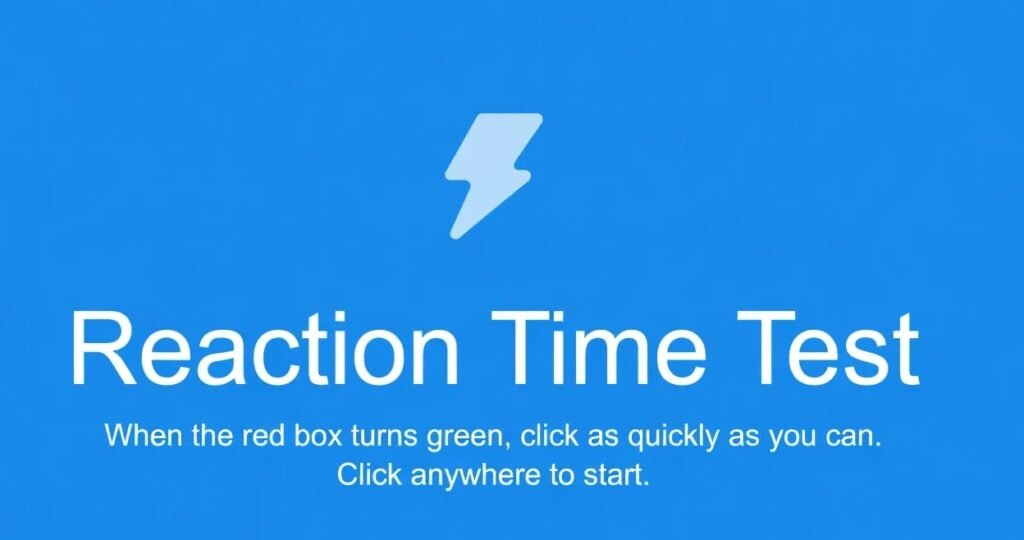
⚡ How it Works ReactionTimeTest.in
Our tool is built for speed and simplicity. Follow these steps to get an accurate reading of your reflexes:
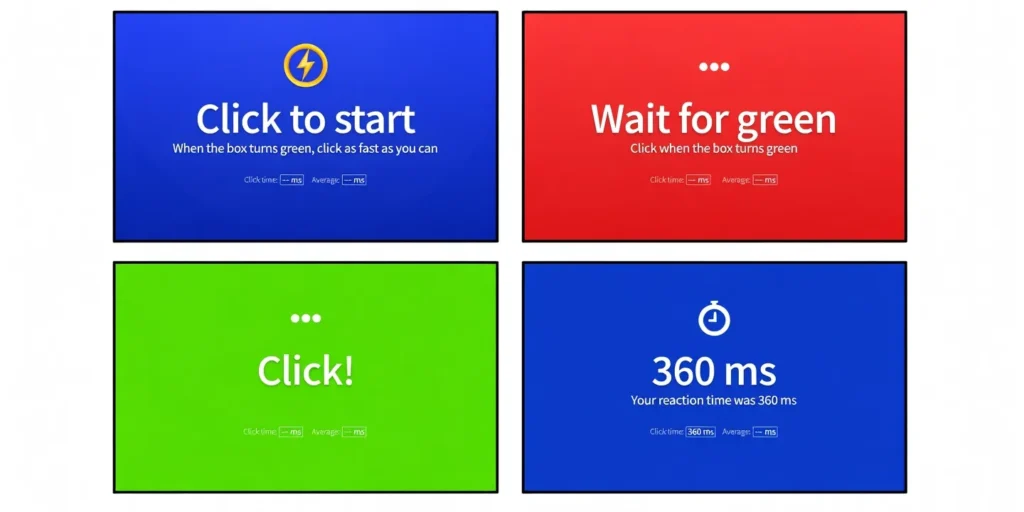
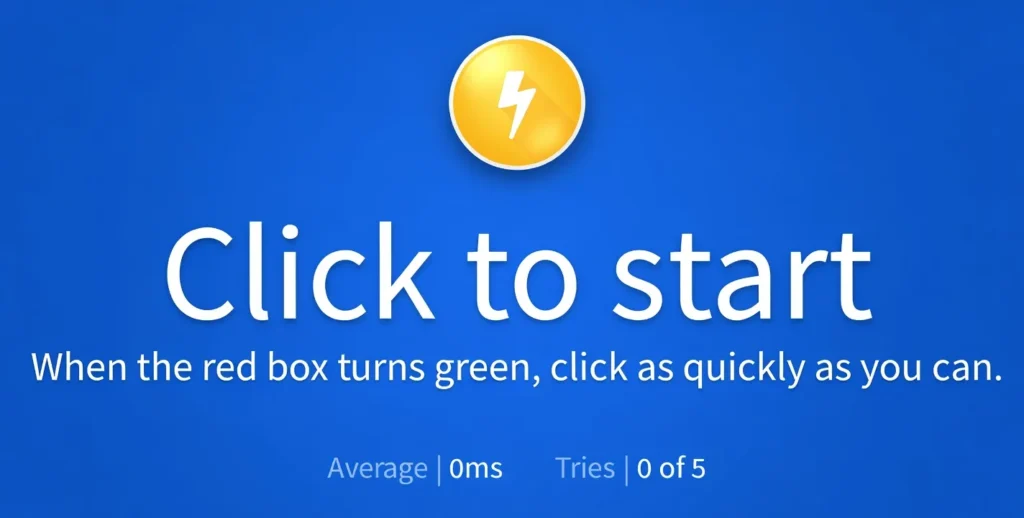
- Initiate: Click anywhere on the Blue screen to start the sequence.
- Focus: The screen will turn Red. This is your cue to stay alert and prepare to react.
- Reaction: The moment the screen turns GREEN, click as fast as you can!
- Instant Result: Your reaction score will appear in milliseconds. You can then view how you compare to others on our Average Statistics Graph.
Average Reaction Time Statistics: Where Do You Stand?
Based on data from global gamers and everyday users, we have established these benchmarks:
- ⚡ Super-Fast (150ms - 200ms): This elite score is typical for professional gamers and top-tier athletes.
- 🏃 Average Human (250ms - 280ms): Most people fall into this range during their first few attempts.
- 🐢 Slow (350ms+): If your score is in this range, you might be tired, or your hardware (mouse/monitor) might have high latency.
Why Use This Online Reaction Timer?
Testing your speed is not just for entertainment; it serves several practical purposes:
- Improve Gaming Performance: Competitive players use this as a Click Speed Test to track their daily performance and warm up before matches.
- Monitor Brain Health: It is a great way to check your focus, concentration levels, and cognitive processing speed.
- Hardware Latency Check: Sometimes a slow score isn't you—it's your gear. Use this tool to test if a new mouse or high-refresh-rate monitor actually improves your Mouse Click Latency.
How to Improve Your Reaction Time: 7 Proven Ways to Get Faster
Whether you’re a professional athlete, a competitive gamer, or just someone looking to sharpen their mind, improving your reaction time is a game-changer. Reaction time is the measure of how quickly you can respond to a stimulus—and the good news is, it's a skill you can train.
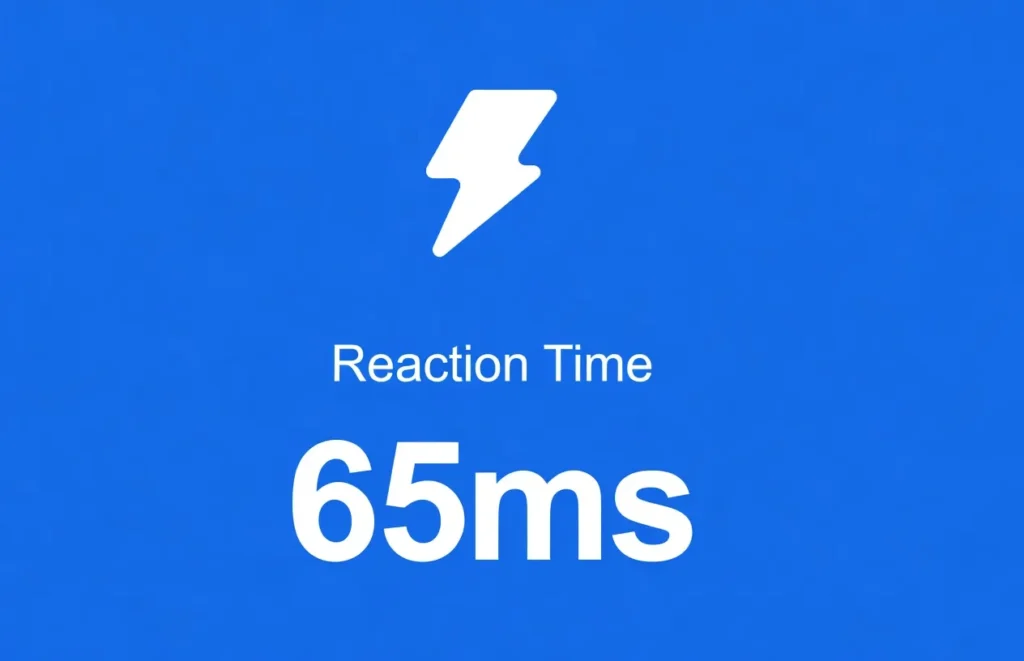
If your scores on our Reaction Time Test aren't where you want them to be, don't worry. Follow these 7 science-backed tips to shave off those extra milliseconds.
1. Practice with Specific Drills
The best way to get faster at a specific task is to do it repeatedly.
- Gamers: Spend 15 minutes in an "Aim Trainer" like Aim Lab or KovaaK's before jumping into a match.
- Cricketers: Use a reaction ball—a multi-sided rubber ball that bounces unpredictably—to sharpen your hand-eye coordination.
- General: Use our F1 Start Light Test regularly to train your brain for "lights-out" scenarios.
2. Optimize Your Physical Health
Your brain is part of your body; if your body is sluggish, your mind will be too.
- Prioritize Sleep: Even one night of poor sleep (less than 7 hours) can slow your reaction time as much as being drunk. Sleep is when your brain repairs neural pathways.
- Stay Hydrated: Dehydration causes mental fatigue and slows down the transmission of signals between your brain and muscles.
3. The Power of Meditation & Focus
Reaction time isn't just about speed; it's about concentration.
- Mindfulness: Meditation helps reduce "mental noise." A clear, focused mind can identify a stimulus (like the green screen) much faster than a distracted one.
- Anticipation: Learn to recognize the "pre-signals." In sports, this means watching the bowler's hand; in gaming, it means listening for footsteps.
4. Proper Nutrition & Supplementation
What you eat affects how fast your neurons fire.
- Omega-3 Fatty Acids: Found in fish oil and walnuts, these are essential for brain health and signal speed.
- Antioxidants: Berries and dark chocolate help protect brain cells from stress, keeping your reflexes sharp as you age.
5. Cognitive Training Games
Fast-paced mental exercises force your brain to rewire itself for speed.
- Action Video Games: Research shows that gamers who play FPS (First-Person Shooter) games have significantly faster reaction times than non-gamers because they are constantly processing high-speed visual data.
- Dual N-Back: This memory task is proven to improve fluid intelligence and processing speed.
6. Warm-Up Your Nervous System
Just like you warm up your muscles before a workout, you need to warm up your Central Nervous System (CNS).
- Plyometrics: Short bursts of explosive movement, like box jumps or high-speed sprints, "wake up" your nervous system and prepare it for rapid fire.
7. Check Your Hardware (The "Hidden" Delay)
Sometimes, the delay isn't in your brain—it's in your gear.
- Monitor Refresh Rate: A 144Hz or 240Hz monitor displays information much faster than a standard 60Hz screen.
- Mouse Latency: Use a wired gaming mouse with a high polling rate (1000Hz+) to ensure your click is registered instantly.
Share Your Score & Challenge Friends!
Our tool comes with built-in WhatsApp and Twitter (X) sharing features. Once you finish the test, you can instantly post your score and see if your friends can beat your record!
Conclusion
Improving your reaction time doesn't happen overnight. It requires consistent practice, a healthy lifestyle, and the right equipment. Bookmark this page and come back daily to test your progress on our tools.
Frequently Asked Questions (FAQ)
What is a good reaction time?
The average human reaction time is approximately 273 milliseconds. However, professional athletes and elite gamers often achieve scores between 150ms and 200ms. Anything below 150ms is considered world-class, while scores above 350ms may be affected by fatigue or hardware lag.
Can I improve my reaction time?
Yes! Reaction time is a skill that can be sharpened through consistent practice, proper sleep, and cognitive training. Using tools like our Cricket Reflex Test or F1 Start Challenge daily can help train your brain to process visual stimuli faster.
Does hardware affect my test results?
Absolutely. Hardware latency (input lag) can add 10ms to 50ms to your score. For the most accurate results, use a 144Hz+ monitor and a wired gaming mouse. Testing on a mobile phone or via a wireless connection may result in slightly slower scores due to screen touch latency and signal delay.
Why is my reaction time slower on mobile?
Mobile devices usually have higher touch latency compared to a physical mouse click. Additionally, the refresh rates on standard mobile screens are often lower than gaming monitors, which can make your reaction time appear 50ms–100ms slower than it actually is.
What is the "Human Benchmark"?
The Human Benchmark is a famous standard used to compare human cognitive abilities. Our test follows similar logic, providing you with a millisecond-based score and a graphical comparison against global averages.
Can caffeine improve my reflexes?
In the short term, yes. Caffeine is a stimulant that can increase alertness and speed up the central nervous system. However, excessive intake or "crashing" after the effects wear off can actually lead to slower reaction times and poor focus.
Why did I get a "Too Soon" or "Jump Start" error?
If you click before the screen turns green (or before the F1 lights go out), the system registers a "False Start." This is designed to prevent users from guessing or "predicting" the timing rather than actually reacting to the visual cue.